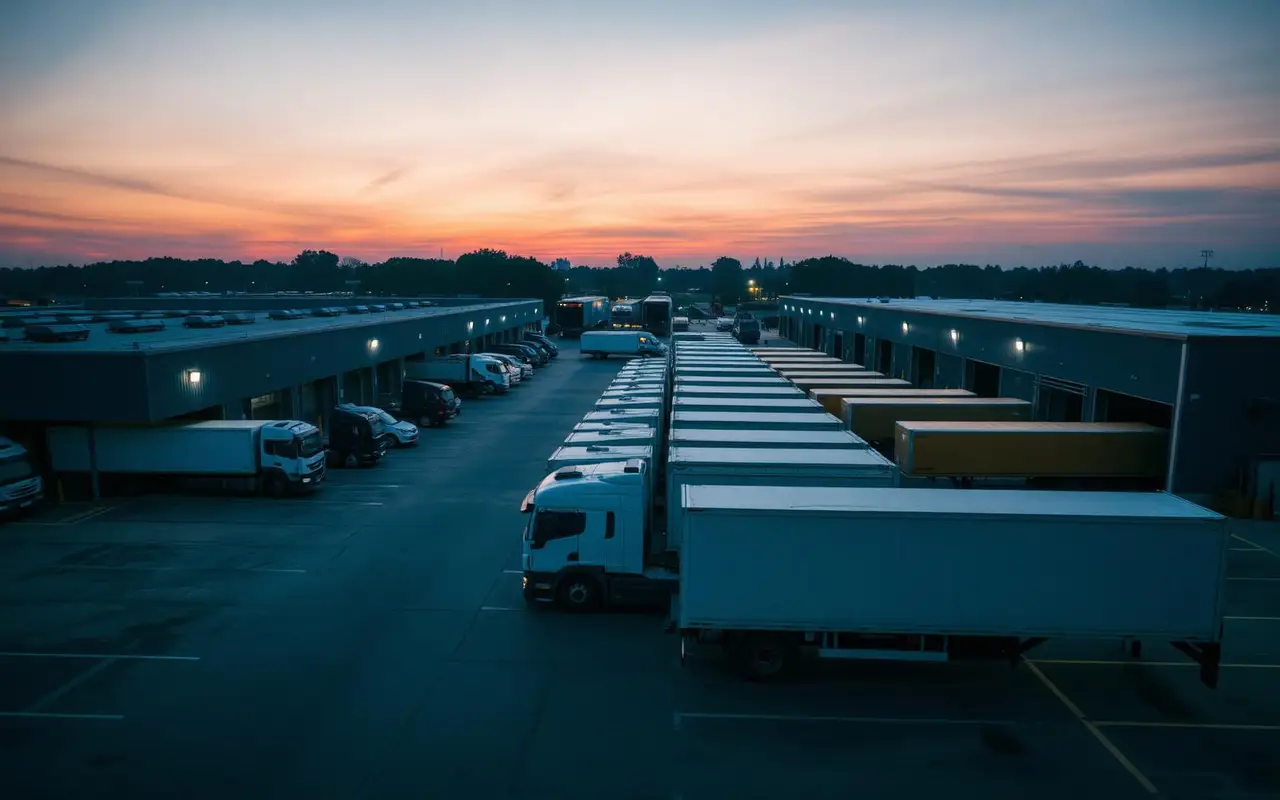
Right now, a shipping planner can book a transpacific container for roughly a third of what it cost three years ago, and still watch her company's total logistics cost climb. Ocean freight is in a glut — new capacity equal to nearly a third of the current global fleet is on order and hitting the water, and long-haul rates have fallen by double digits over the past year. Meanwhile the leg of the journey that actually reaches the customer has gotten steadily more expensive: last-mile delivery's share of total shipping cost rose from 41% to 53% in five years, and it keeps climbing as customers demand faster, cheaper delivery on smaller, more frequent orders. Two legs of the same supply chain, moving in opposite directions. Most companies are still managing them with the same playbook.
That mismatch is the real story of supply chain after globalization. It isn't that global trade shrank — it didn't. It reorganized, unevenly, and the cost, capacity, and risk picture now looks completely different depending on which leg of the network you're looking at. Operators who are still optimizing the whole chain as one line item are missing where the leverage — and the exposure — actually sits.
The Three Shifts Actually Redrawing the Map
Where production happens. The dominant move of the last few years has not been reshoring everything home — it has been regionalization: production moving closer to the markets it serves, through a combination of nearshoring and dual- or multi-sourcing rather than a single relocated factory. DHL's 2026 trade outlook points to Central European hubs — Poland, Czechia, Romania, Hungary — absorbing manufacturing that used to sit further east, while Mexico, Turkey, and Southeast Asia serve as the complementary near-shore options for companies diversifying out of single-country dependence. The map isn't getting smaller. It's getting more redundant, on purpose.
What it costs to move it. Ocean freight and inland freight are behaving like two different markets right now, not one. On the water, an orderbook equal to roughly a third of the existing container fleet is being delivered into a market where demand hasn't kept pace, pushing long-haul rates down sharply and likely into a multi-year downcycle. On the road, it's closer to the opposite: tightening regulatory enforcement and driver capacity have pushed carrier tender rejection rates up, handing leverage back to carriers after years of surplus capacity. A company celebrating a cheaper ocean contract while its domestic transportation costs quietly climb is optimizing the wrong leg.
Who actually operates it. The 3PL market is consolidating quickly — deal volume was up roughly 20% year over year through mid-2026, driven heavily by private equity, and the top handful of players now control something close to half of total market share. What's notable is what buyers are paying up for: not scale for its own sake, but differentiated, technology-enabled platforms with embedded customer relationships — while commoditized, undifferentiated capacity is getting squeezed. Managed transportation services alone saw roughly three times the acquisition activity of a year earlier. The 3PL partner that was a reliable commodity option two years ago may not be the same kind of asset today.
What This Looks Like Inside a Real Network
None of this is theoretical for the operators who have actually run global freight and distribution through a repricing cycle. Redesigning a global distribution network for a luxury goods company around freight and turnaround standards — rather than around whichever ocean rate looked best that quarter — cut freight and transportation cost by 46% while improving order turnaround, because the network was rebuilt around total landed cost per lane instead of the headline number on any single contract. Standardizing operations across a US and European facility network during an international expansion meant treating cost-per-unit and outbound processing time as one connected system, not two regional stories — the kind of discipline that matters more, not less, as the ocean and inland legs of a network start behaving like different markets. And redesigning a distribution footprint for a major FMCG client inside its own existing infrastructure — rather than proposing a bespoke build — is the same instinct the current environment rewards: model the whole network honestly before recommending a change to any single piece of it.
The Trap Most Operators Fall Into
The trap is chasing the visible number instead of modeling the whole lane. Ocean rates are the headline everyone sees, so they get the negotiating attention, while last-mile cost — now the single largest and fastest-growing piece of total delivered cost in most consumer and retail networks — gets managed as a fixed tax instead of a lever. A company can win a great ocean freight renewal and still lose the year on delivered cost, because nobody modeled the total landed cost per lane, only the piece that was easiest to benchmark.
The second trap is treating nearshoring as risk reduction by itself. Moving a single-source supplier from one country to a closer one does not remove the single point of failure — it just relocates it. Real resilience still requires the discipline of a second qualified source, regardless of how close the primary one now sits. Proximity is not the same thing as redundancy.
What Operators Should Do Now
- Model total landed cost per lane, not the headline freight rate. Ocean, inland, warehousing, and last mile need to sit in the same view, or the cheap leg will keep masking the expensive one.
- Treat last-mile cost as a designed lever, not an accepted cost of doing business. Route density, delivery-window flexibility, and fulfillment-node placement move this number more than any carrier negotiation will.
- Evaluate 3PL and freight partners on capability, not just capacity. In a consolidating market, the differentiated, technology-enabled operators are pulling ahead of the commodity players — the partner decision matters more than it did when capacity itself was the scarce resource.
- Keep the dual-sourcing discipline even after nearshoring. A shorter supply chain is not automatically a more resilient one unless it still has a second qualified option behind it.
The Atelier Standard
This is exactly the terrain the Atelier Operating Cadence was built for: assess the network as it actually behaves today, not as the old globalization-era map assumed; standardize the operating model across whichever combination of near-shore and offshore sourcing the business settles on; execute the freight and 3PL decisions with someone who has actually run a network through this kind of repricing, not just modeled it; and sustain the discipline as the map keeps shifting, because it will keep shifting. The operators who came up running global logistics networks — moving volume across borders, renegotiating freight through a rate cycle, standing up a new region's distribution footprint from scratch — are the ones equipped to see that the three shifts above are not three separate stories. They are one supply chain, priced unevenly, waiting for someone to look at the whole lane instead of the leg that made the headline.